News from around the Archdiocese of Liverpool
Walking Pilgrimage of the Month - October
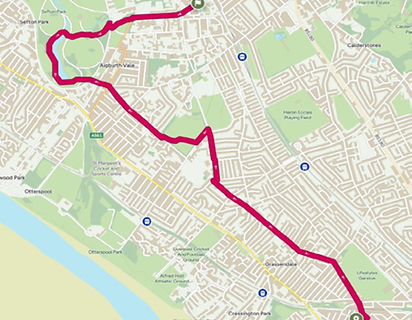
This month’s Pilgrimage Walk is modelled after the recent Care for Creation walk, which celebrated the 800th Jubilee of St Francis.
“
Care for Creation:
St Francis Jubilee Walk 2026
This month’s Pilgrimage Walk is modelled after the recent Care for Creation walk, which celebrated the 800th Jubilee of St Francis.
Our pilgrimage begins at St Francis of Assisi Church in Garston, an especially fitting place to begin a walk celebrating the Season of Creation and the 800th anniversary of the death of St Francis. From here, the route takes us for approximately 3.6 miles, gradually leaving the busier streets behind and entering some of the beautiful green spaces of south Liverpool, before eventually reaching St Anthony of Padua Church in Mossley Hill.
1. Setting out from St Francis of Assisi
Leaving St Francis, we begin by walking through the residential streets of Garston and Grassendale. This first part of the journey gives us time to settle into the rhythm of pilgrimage. We are still very much surrounded by the city: houses, roads, traffic and the ordinary activity of daily life.
That is important. Care for creation is not something confined to spectacular landscapes or remote countryside. Creation is where we live. Our streets, gardens, trees and neighbourhoods are part of our common home too. As we walk, we might begin to notice things that we would normally pass without a second glance: a tree growing beside the pavement, birds overhead, flowers in a garden, or simply the people alongside us.
2. Towards Sudley House
The route gradually brings us towards Mossley Hill and the grounds of Sudley House. Here there is a noticeable change in the character of the walk as streets give way to grass, mature trees and open space.
Sudley provides a natural opportunity to slow down. The grounds fall away from the houses through gardens and open land, creating a transition between the built environment and the larger landscape of Sefton Park beyond. A walking route through Sudley can lead down towards North Sudley Road and onwards towards Sefton Park.
3. From Sudley into Sefton Park
Leaving the Sudley grounds, our pilgrimage continues towards Sefton Park. Crossing into the park marks another change in our surroundings. The noise of the road begins to recede, and we find ourselves among open grassland, mature trees and winding paths.
Sefton Park is one of Liverpool’s great historic green spaces. Its landscape was deliberately created with sweeping lawns, curving paths and water, giving the impression of moving through natural countryside within the city.
Here, the invitation is simply to notice. Notice the variety of trees. Listen to the birds and the movement of leaves. Look at the changing light and sky. Notice the people enjoying the same space in many different ways.
For a pilgrimage concerned with care for creation, this part of the walk reminds us that creation is not merely something to admire. It is something of which we ourselves are a part and for which we share responsibility.
4. Walking around the lake
Eventually the path brings us to one of the great features of Sefton Park: its lake. The lake was created by damming two streams and forms a central feature within the park’s landscape.
Our route follows the water, giving us perhaps the most reflective section of the pilgrimage.
Walking beside water naturally invites us to slow our pace. There is movement everywhere—the surface of the lake, birds on the water, trees reflected in it, people passing along its banks.
Rather than rushing through this part of the walk, it is a place to look, listen, and linger. Creation becomes not simply the background to our prayer, but part of the prayer itself.
5. Leaving Sefton Park
Having followed the lake and paths through the park, we eventually begin to turn away from the water and make our way towards Mossley Hill.
There is something significant about leaving the beauty and spaciousness of the park and returning once more to streets and houses. Christian care for creation cannot remain only an experience enjoyed in beautiful, natural surroundings. What we have noticed must travel home with us.
6. The final path to St Anthony’s
Our final stretch takes us through Mossley Hill towards St Anthony of Padua Church on Queens Drive. The destination brings the Franciscan character of the pilgrimage full circle. We began at a church dedicated to St Francis of Assisi and finish at one dedicated to St Anthony of Padua, another of the great Franciscan saints. St Anthony’s is itself served by the Order of Friars Minor Conventual, part of the Franciscan family.